


Page 4 - Glossary of Shipping Terms
P. 4
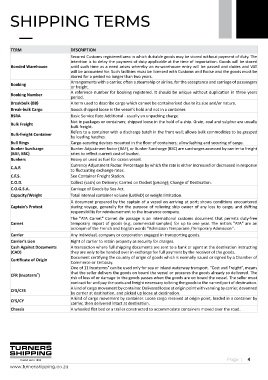
SHIPPING TERMS

TERM                       DESCRIPTION

Bonded Warehouse           Secured Customs registered area in which dutiable goods may be stored without payment of duty. The
                           intention is to delay the payment of duty applicable at the time of importation. Goods will be stored
Booking                    until such time as a need arises whereby an ex-warehouse entry will be passed and duties and VAT
                           will be accounted for. Such facilities must be licensed with Customs and Excise and the goods must be
Booking Number             stored for a period no longer than two years.
Breakbulk (BB)             Arrangements with a carrier, often a steamship or airline, for the acceptance and carriage of passengers
Break-bulk Cargo           or freight.
BSRA                       A reference number for booking registered. It should be unique without duplication in three years
Bulk Freight               period.

Bulk-freight Container     A term used to describe cargo which cannot be containerised due to its size and/or nature.
Bull Rings
Bunker Surcharge           Goods shipped loose in the vessel’s hold and not in a container.
(BAF, BSC)
Bunkers                    Basic Service Rate Additional - usually an unpacking charge.
C.A.F.
C.F.S.                     Not in packages or containers; shipped loose in the hold of a ship. Grain, coal and sulphur are usually
C.O.D.                     bulk freight.
C.O.G.S.A.                 Refers to a container with a discharge batch in the front wall; allows bulk commodities to be grasped
Capacity/Weight            by loading hatches.

Captain's Protest          Cargo-securing devices mounted in the floor of containers; allow lashing and securing of cargo.

Carnet                     Bunker Adjustment factor (BAF), or Bunker Surcharge (BSC) are surcharges assessed by carrier to freight
                           rates to reflect current cost of bunker.
Carrier
Carrier's Lien             Heavy oil used as fuel for ocean vessel.
Cash Against Documents
(CAD)                      Currency Adjustment Factor. Percentage by which the rate is either increased or decreased in response
Certificate of Origin      to fluctuating exchange rates.

CFR (Incoterm®)            See Container Freight Station.

CFS/CFS                    Collect (cash) on Delivery; Carried on Docket (pricing); Change of Destination.

CFS/CY                     Carriage of Goods by Sea Act.
Chassis
                           Total internal container volume (LxWxD) or weight limitation.

                           A document prepared by the captain of a vessel on arriving at port; shows conditions encountered
                           during voyage, generally for the purpose of relieving ship owner of any loss to cargo, and shifting
                           responsibility for reimbursement to the insurance company.

                           The "ATA Carnet" Carnet de passage is an international customs document that permits duty-free
                           temporary import of goods (e.g. commercial samples) for up to one year. The initials "ATA" are an
                           acronym of the French and English words "Admission Temporaire /Temporary Admission".

                           Any individual, company or corporation engaged in transporting goods.

                           Right of carrier to retain property as security for charges.

                           A transaction where full shipping documents are sent to a bank or agent at the destination instructing
                           they are only to be handed over in exchange for full payment by the receiver of the goods.
                           Document certifying the country of origin of goods which is normally issued or signed by a Chamber of
                           Commerce or Embassy.
                           One of 11 Incoterms® can be used only for sea or inland waterway transport. “Cost and Freight”, means
                           that the seller delivers the goods on board the vessel or procures the goods already so delivered. The
                           risk of loss of or damage to the goods passes when the goods are on board the vessel. The seller must
                           contract for and pay the costs and freight necessary to bring the goods to the named port of destination.
                           A kind of cargo movement by container. Delivered loose at origin point with vanning by carrier, devanned
                           by carrier at destination, and picked up loose at destination.
                           A kind of cargo movement by container. Loose cargo received at origin point, loaded in a container by
                           carrier, then delivered intact at destination.

                           A wheeled flat bed or a trailer constructed to accommodate containers moved over the road.

                           Page | 4

www.turnersshipping.co.za

